SDS Studio™
Key takeaways
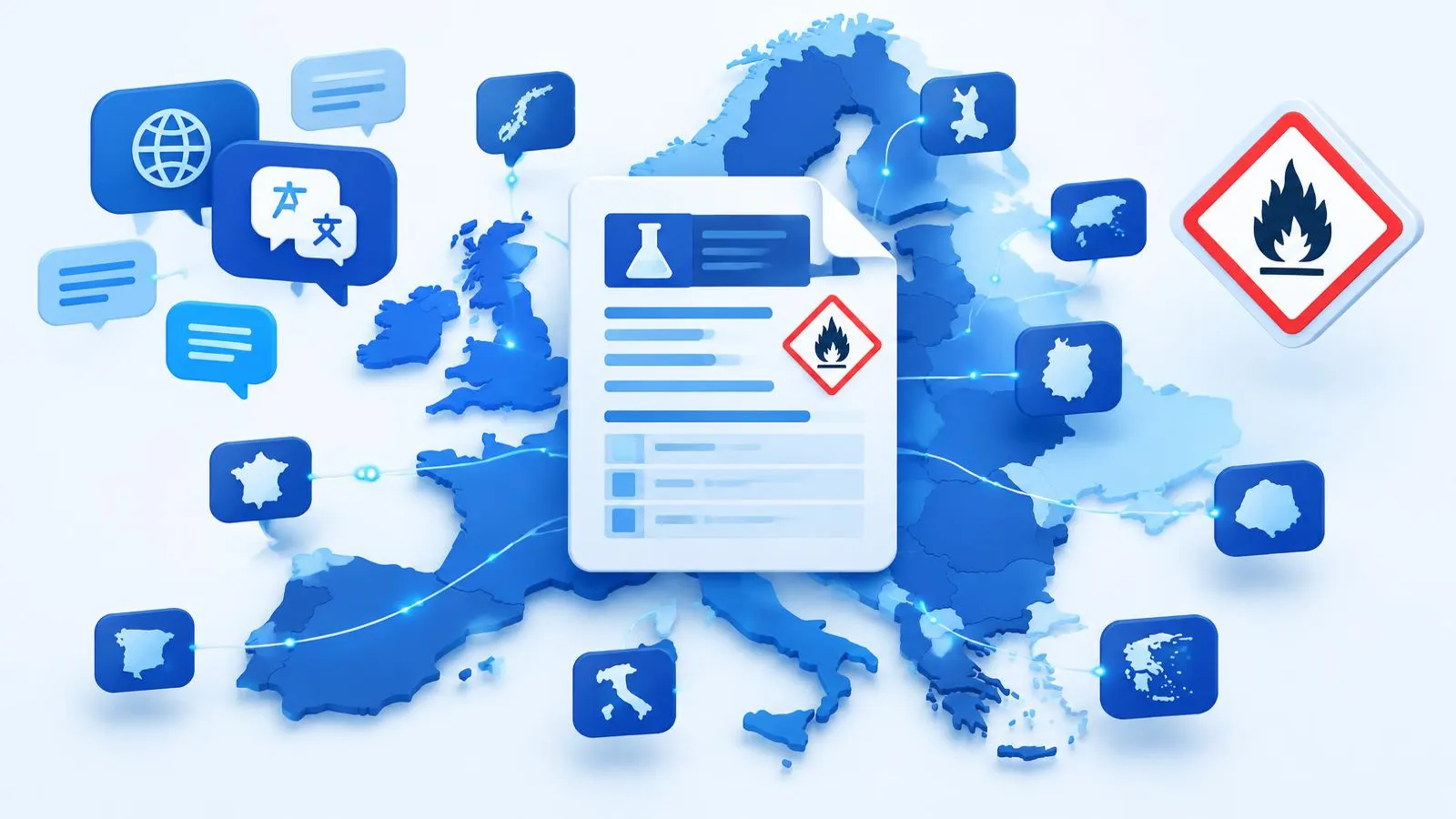
- REACH Article 31(5) requires the SDS in the official language of the Member State where the product is placed on the market.
- A word-for-word translation keeps the source country's laws, limits and phone numbers, which is wrong for the new market.
- Sections 1.4, 8 and 15 must be rebuilt for the target country; Sections 2 and 3 use the official CLP texts of that language.
- The CLP label and the poison centre (PCN) notification follow the same country, so plan them together.
- SDS Studio™ translates into 28 languages and fills the country sections from target-country data, for €59 + VAT per SDS.
What does EU law require for SDS languages?
In practice this means: if you sell the same product in Germany, France and Poland, you need three SDSs, one in German, one in French and one in Polish. Countries with several official languages, such as Belgium or Switzerland, may require more than one version depending on where you sell.
The obligation sits with the supplier who places the product on that market: the manufacturer, importer or distributor. A distributor who receives a foreign SDS cannot simply pass it on to customers in another country.
Why is a plain translation not a compliant SDS?
An SDS is partly a technical text and partly a legal document of one specific country. A translation agency translates what is written, so a German SDS translated into French still cites German laws, German exposure limits and a German emergency number. For a French customer this sheet is incomplete, even if every sentence is well translated.
Which SDS sections change from country to country?
| Section | What changes | Why |
|---|---|---|
| 1.4 Emergency telephone | Number and service of the target country, often the national poison centre | Users must reach help in their own country and language |
| 2 Hazards, label elements | Official H, EUH and P statement texts in the target language | CLP Annexes III and IV define the exact wording per language |
| 3 Composition | Official substance names where harmonised | Annex VI and ECHA provide localised names |
| 8 Exposure controls | National occupational exposure limits and their legal source | Limit values and their legal basis differ by Member State |
| 14 Transport | Official ADR names in the target language | Transport documents use the national language |
| 15 Regulatory information | National laws on chemicals, workplace safety, waste and water hazard | Each country has its own legislation next to EU law |
| 16 Other information | Full texts of H/EUH statements in the target language | Must match Sections 2 and 3 |
Sections 4 to 7 and 9 to 12 mostly carry over: they are translated, but their content does not depend on the country. Country-specific content sits in Sections 1.4, 8, 13 (national waste law references; the waste codes themselves are EU-wide) and 15. A Member State may also accept further languages under Article 31(5), so check each target country. The product classification itself (CLP) is the same across the EU, because CLP is directly applicable in every Member State.
Language requirements in key markets
| Market | SDS language | Notes |
|---|---|---|
| Germany, Austria | German | National OELs and water hazard class information are frequently checked |
| France | French | Poison centre notification via the French system |
| Italy | Italian | National OEL references in Section 8 |
| Spain | Spanish | National OEL list (INSST limits) in Section 8 |
| Poland | Polish | National NDS limits in Section 8 |
| Netherlands | Dutch | National limit values in Section 8 |
| Belgium | Dutch, French or German, depending on the region of sale | Often supplied in several languages |
| Turkey (outside the EU) | Turkish | KKDIK rules; SDS prepared by a certified SDS preparer |
| China (outside the EU) | Simplified Chinese | National GB standards define a separate SDS format |
Common mistakes when translating safety data sheets
- Section 15 still lists the laws of the origin country.
- Section 8 shows exposure limits of the wrong country, or no legal source at all.
- The emergency number in 1.4 is not reachable from the target country.
- H and P statements are translated freely instead of using the official CLP wording.
- Section 16 abbreviations and full H texts remain in the source language.
- The label is not updated together with the SDS.
- The revision date and version are not adjusted for the new edition.
How to translate an SDS for a new EU country, step by step
- Check the source SDSIt should already follow Regulation (EU) 2020/878. If not, update it first; translating an outdated SDS doubles the work.
- Choose language and target country separatelyThe language sets the wording, the country sets the legal content. Belgium in French and France in French are not the same SDS.
- Use official phrase textsTake H, EUH and P statements from the official CLP texts of the target language, never from a free translation.
- Rebuild Sections 1.4, 8 and 15Insert the target-country emergency number, national exposure limits and national legislation.
- Align label and PCNUpdate the CLP label and check whether a poison centre notification is needed in the new country.
- Review and releaseA competent person reviews the result before you supply it to customers.
How SDS Studio™ handles translation
In SDS Studio™ you upload your existing SDS, select the target language and the target country, and the software produces a new edition: official H, EUH and P texts from its phrase catalogue, Sections 1.4, 8 and 15 filled from target-country data, and transport names from ADR tables. Product and company names stay unchanged, and every field remains editable before release.
SDS Studio™ supports 28 languages. In our recorded demo, an English translation of a German SDS took about 8 minutes of processing. The price is €59 + VAT per SDS and language, without subscription, and the first project of each company is free.
Frequently asked questions
Is a translated SDS legally valid in another EU country?
Only if, besides the language, the country-specific content is adapted: emergency number (1.4), national exposure limits (8) and national legislation (15). A literal translation usually is not enough.
Can a distributor translate the supplier's SDS?
Yes, but the distributor who places the product on the new market becomes responsible for that SDS and must adapt the country-specific sections.
Do I need a new SDS for Austria if I have a German one?
The language is the same, but national laws and exposure limits in Sections 8 and 15 differ, so the German-language SDS for Austria is a separate edition.
How much does an SDS translation cost?
In SDS Studio™ €59 + VAT per SDS and language, including the country adaptation. Agencies and consultants usually quote per page or per document.
Does the classification change in another country?
No. CLP applies directly in all Member States, so the classification stays the same. Wording, national limits and laws change.